Low Stress Training And Increasing Cannabis Yield
If you’ve spent much time around the internet, you’ve surely seen pictures of trichome covered cannabis plants leaning heavily, supporting the weight of numerous fruitful cola. Although the cannabis plant is great at producing a single dominant cola, with a little guidance and coaching you can increase your yield-per-plant and grow a plant the pro’s would be proud of. This article describes what low stress training (LST) is, and how to apply it towards great results.
1. LST In a Nutshell
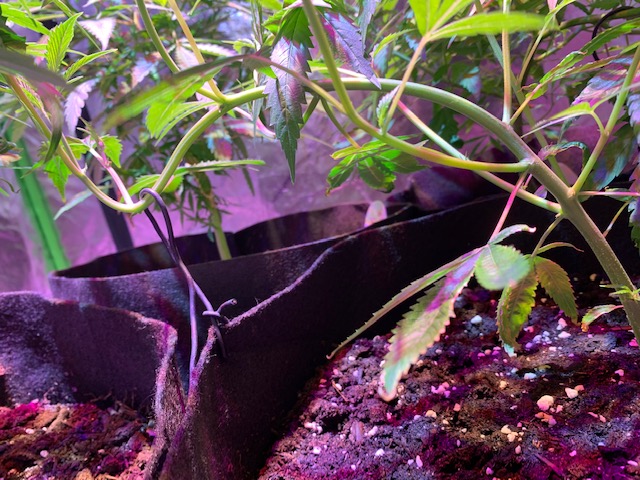
For low stress training, the cannabis plant is “tricked” into growing a fuller, bushier canopy. By pulling the apical node lower than other nodes on the plant, the cannabis responds by filling out newly exposed node sites. Often growers will use twine or wire wraps to pull the apical node sideways, exposing otherwise shaded out branches of the plant. This technique is one that works great both outdoors and in indoor grows to ensure a controlled, even canopy within limited space. Whether tent growing or greenhouse growing, low stress training cannabis will lead to beautiful, bountiful harvests if done correctly.
2. The Do’s of LST
In applying LST, it is important to understand how your light is interacting with your plants. By positioning your plants tactically under a grow light, you can minimize light waste within your grow room. When deciding which way to pull your plant down, consider whether it will get more or less light in that position. Remember: the plant will seek the light out as it grows. This allows you to pick the position and let the plant do the work. Within days of low stress training a plant, you’ll see previously dormant nodes explode with new life. Node structures begin to bulk up and new branches will soon rise towards the light. When doing this, pay attention to the larger fan leaves and the shade they create. It can be useful to tuck fan leaves that cover new growth underneath so that the new leaves can catch more light. Additionally, lower leaves that will no longer receive light can be pruned to increase airflow and reduce the chances of mold and pest issues. One important factor with LST is also factoring in the amount of weight that your forming flowers will add. With the manipulation of the plant creating more flower growth sites, the additional weight can become problematic. Growers often use the screen of green technique (SCROG) to provide extra support to their bud-laden plants with a suspended net. Other growers apply the sea of green (SOG) technique so that the sheer volume of plants will support each other. This technique is also useful for minimizing light waste. Check out this video on SCROG and SOG for a firsthand look into these techniques.
3. The Dont’s of LST
When implementing low stress training it is crucial that the grower is aware of the limitations of their plant. If too much pull is applied, it can strain the plant to its breaking point. One critical error made is tugging a freshly watered plant over. When plant tissue is full of water, its cell walls are at their most rigid. Applying too much pull in this state can break the stalk clean in half, which is not the goal! Another mistake to avoid is the tying of plants. When cannabis plants grow, they not only grow up, but wider as well. If ties are being used on a growing branch it can stunt the growth of that branch and cause weakness. Rather then tying tightly, loop your fastener in a way that allows the plant stem to grow wider. With a soft wire you can form a “hook” that makes it easy to leave space and adjust your plant or fastener. Lastly, a big mistake with LST comes in the form of positioning. Pulling your plant out of direct light, or too far from light can rob it off important energy to put towards its development. This is particularly bad in low stress training because the plant is being pushed into generating a lot of new branches; make sure it still has the light to support this growth.
4. Alternatives to LST
Although low stress training is a popular technique for increasing yield, it is not the only one. Other techniques such as super-cropping, topping and FIM can be tactically applied to the same effect. Often, these approaches are used in conjunction with one another with great results. For more information on these techniques, check out this useful article that breaks down each technique, and its pro’s and cons. Additionally, watching videos can help understand the application of any given one; check out this informative video for a professional explanation!
Recent Comments